
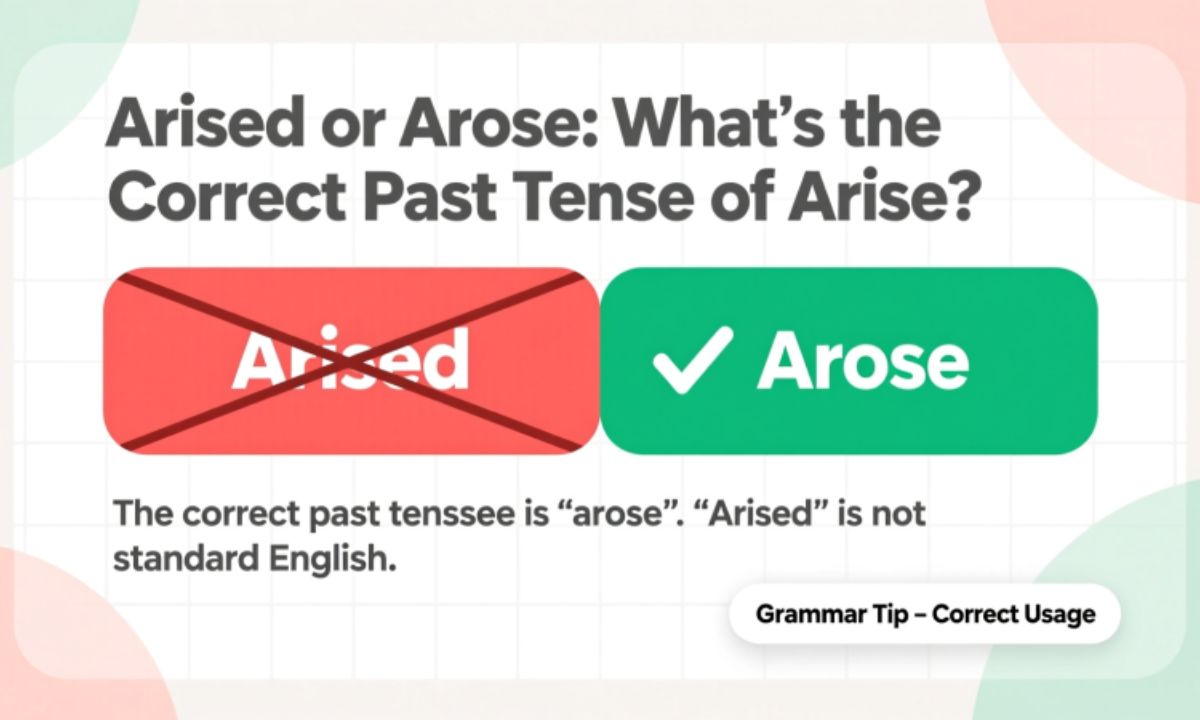

Ever stumbled over whether to write “arose” or “arised”? This common grammar mistake puzzles writers everywhere. Understanding Arised or Arose What’s the Correct Past Tense of Arise matters for clear, professional communication.
English grammar rules aren’t always straightforward, especially with irregular verbs. The confusion between arose vs arised represents a classic example of how verb conjugation challenges both native speakers and ESL learners seeking grammatical correctness.
The Rise of Confusion: Why “Arise” Trips Us Up
Irregular verbs don’t follow standard patterns, making “arise” particularly tricky. Unlike regular verbs adding “-ed,” this strong verb transforms completely. The past tense of arise follows ancient Old English verbs patterns, not Modern English grammar conventions we expect.
Writers naturally want to apply familiar rules universally. We say “surprised” and “comprised,” so “arised” feels logical. However, this verb tense confusion leads directly to errors.
Understanding why arised is incorrect requires recognizing that “arise” belongs to an elite group of English irregular verbs preserving historical conjugation patterns.
Read Also This: https://celebsmeaningcom.com/imao-meaning/
Arise: More Than Just Getting Out of Bed
Before exploring correct usage of “arise”, let’s examine its versatile meanings. This intransitive verb serves multiple purposes beyond physical rising. Understanding context helps avoid ESL grammar issues and ensures proper application across different situations.
The verb “arise” differs subtly from “rise.” While rise vs arise often confuses learners, “arise” typically suggests emergence of abstract concepts or situations. Here’s a comprehensive breakdown showing how to use arise in a sentence:
| Meaning | Example Sentence | Context |
| To get up | She arose from her chair to greet visitors. | Physical movement |
| To come into existence | New challenges arose during implementation. | Abstract emergence |
| To occur | Questions arose about the proposal. | Situations developing |
| To ascend | Smoke arose from the valley below. | Upward movement |
| To originate | The tradition arose centuries ago. | Historical beginning |
The Correct Past Tense: Arose
Let’s settle Arised or Arose What’s the Correct Past Tense of Arise definitively: arose is correct. This isn’t negotiable despite what feels intuitive. The difference between arose and arised is simple, only one exists in proper English grammar.
Here’s the complete verb conjugation breakdown:
- Present tense: arise, arises
- Past tense: arose
- Past participle of arise: arisen
- Present participle of arise: arising
Real-world examples of arose in sentences:
- Present: Problems arise when communication fails.
- Past: The opportunity arose unexpectedly yesterday.
- Past participle: New concerns have arisen recently.
- Present participle: Issues are arising from the policy.
Why “Arised” is a Common Mistake
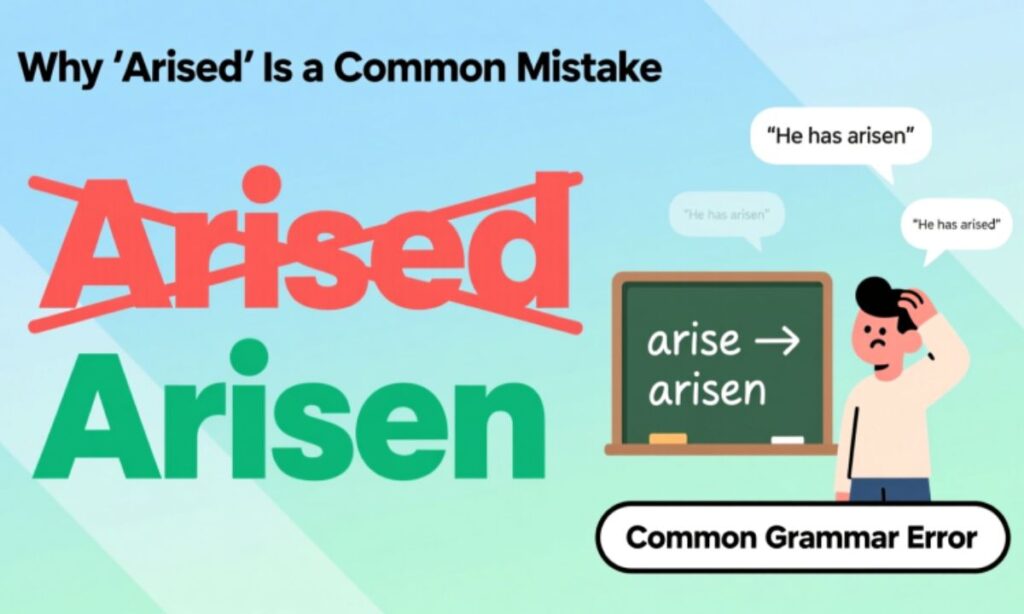
The temptation to use “arised” stems from our brain’s pattern recognition. Regular verb forms in English condition us to add “-ed” automatically. This creates persistent ESL learner challenges and trips up native speakers too.
Strong verb patterns in English like “arise” change their internal vowel sounds rather than adding suffixes. Consider these similar irregular past tense examples:
- Write → Wrote (not “writed”)
- Drive → Drove (not “drived”)
- Sing → Sang (not “singed”)
- Ring → Rang (not “ringed”)
- Begin → Began (not “beginned”)
Understanding this pattern helps cement why “arised” is incorrect. These verb transformation patterns date back to Old English language evolution, preserving ancient linguistic structures that survived into Modern English grammar.
The Evolution of Arise: A Journey Through Time
The history of the word arise reveals why it maintains irregular conjugation. Originating in Old English verbs as “ārīsan,” it carried irregular patterns through centuries. Middle English retained these characteristics, resisting standardization pressures.
This linguistic journey explains modern irregularity:
| Period | Form | Timeframe |
| Old English | ārīsan | Before 1100 CE |
| Middle English | arisen | 1100-1500 CE |
| Early Modern English | arise | 1500-1800 CE |
| Modern English | arise | 1800-present |
The persistence demonstrates “arise” importance in English vocabulary. Such strong verbs represent linguistic fossils, preserving ancient verb conjugation methods largely extinct elsewhere in contemporary language.
Mastering Arise: A Tense-by-Tense Guide
This comprehensive verb tense chart provides clarity for mastering all “arise” forms. Understanding each tense prevents common grammar mistakes and builds confidence in correct verb tense in formal writing.
Present Tense
The present forms cover current, habitual, and ongoing situations. Verb conjugation in present tense shows standard third-person singular changes:
- Simple Present: I/You/We/They arise; He/She/It arises
- Present Continuous: I am arising; You/We/They are arising; He/She/It is arising
- Present Perfect: I/You/We/They have arisen; He/She/It has arisen
Past Tense
Past forms describe completed actions and situations that emerged previously. Remember: arose is always correct for simple past, never “arised”:
- Simple Past: I/You/We/They/He/She/It arose
- Past Continuous: I/He/She/It was arising; You/We/They were arising
- Past Perfect: I/You/We/They/He/She/It had arisen
Future Tense
Future forms express upcoming occurrences or predictions. These constructions follow standard patterns with irregular verbs:
- Simple Future: I/You/We/They/He/She/It will arise
- Future Continuous: I/You/We/They/He/She/It will be arising
- Future Perfect: I/You/We/They/He/She/It will have arisen
Pronunciation Guide: Say It Right
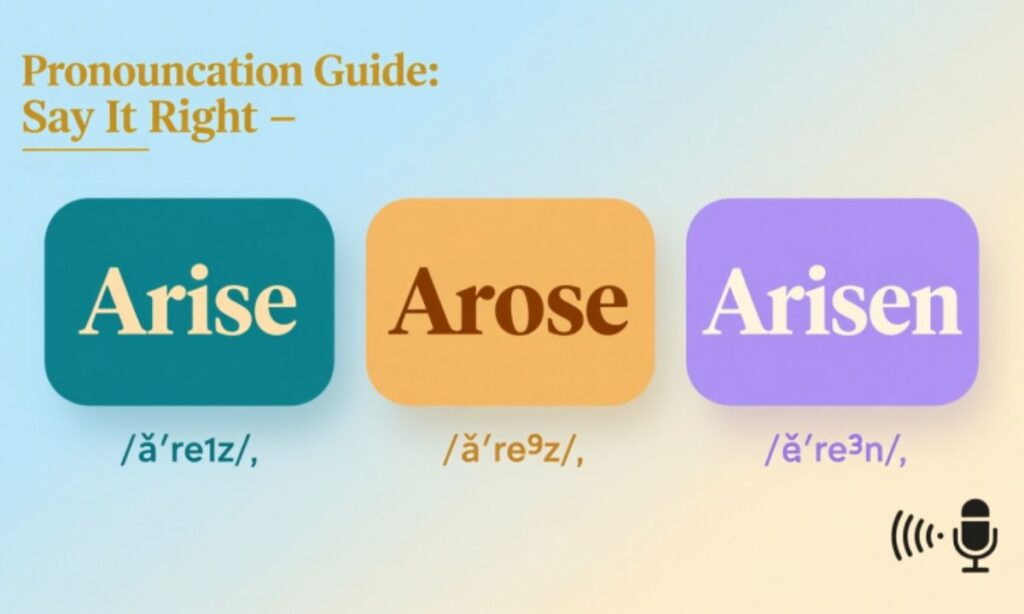
Proper pronunciation of arise enhances spoken communication confidence. The pronunciation differences (arise, arose, arisen) lie primarily in the second syllable’s vowel sound, affecting how words are perceived in conversation.
Master these distinctions:
- Arise: /əˈraɪz/ (uh-RIZE) – rhymes with “surprise”
- Arose: /əˈroʊz/ (uh-ROZE) – rhymes with “compose”
- Arisen: /əˈrɪzən/ (uh-RIZ-en) – middle syllable like “risen”
| Form | Pronunciation | Common Mispronunciation to Avoid |
| Arise | uh-RIZE | a-REEZ |
| Arose | uh-ROZE | a-ROOZ |
| Arisen | uh-RIZ-en | a-RYE-zen |
This pronunciation guide for English verbs helps ESL learners avoid common speaking errors that undermine otherwise correct grammar.
Arise in Action: Real-world Examples
Understanding theoretical rules matters less than seeing how to use arise in a sentence naturally. These examples of arose in literature and other contexts demonstrate versatile application.
Literature and Famous Quotes
Classic literature provides rich examples of arose in literature showing elegant usage:
- “The sun arose upon an altered world.” – Mary Shelley
- “New opportunities arose from unexpected circumstances.” – Modern fiction
- “A murmur arose from the assembled crowd.” – Historical narrative
- “The question arose whether to proceed.” – Contemporary writing
News Headlines
Arise in business language and journalism demonstrates contemporary usage patterns:
- “Economic Concerns Arose Following Market Fluctuations”
- “New Evidence Arose in High-Profile Investigation”
- “Tensions Arose Between Nations Over Trade Policies”
- “Unexpected Challenges Arose During Recovery Efforts”
Business and Legal Contexts
Arise in legal writing requires precision and formality, making correct verb forms in English essential:
- “The contractual obligation arose when both parties signed.”
- “Any disputes arising from this agreement require arbitration.”
- “The need for restructuring arose after quarterly review.”
- “Questions arose regarding compliance with regulations.”
Everyday Usage
Casual conversation equally benefits from correct usage of “arise”:
- “An opportunity arose to visit family abroad.”
- “Misunderstandings arose over scheduling conflicts.”
- “The idea arose during brainstorming sessions.”
- “Concerns arose about privacy settings.”
Synonyms and Related Words: Expanding Your Vocabulary
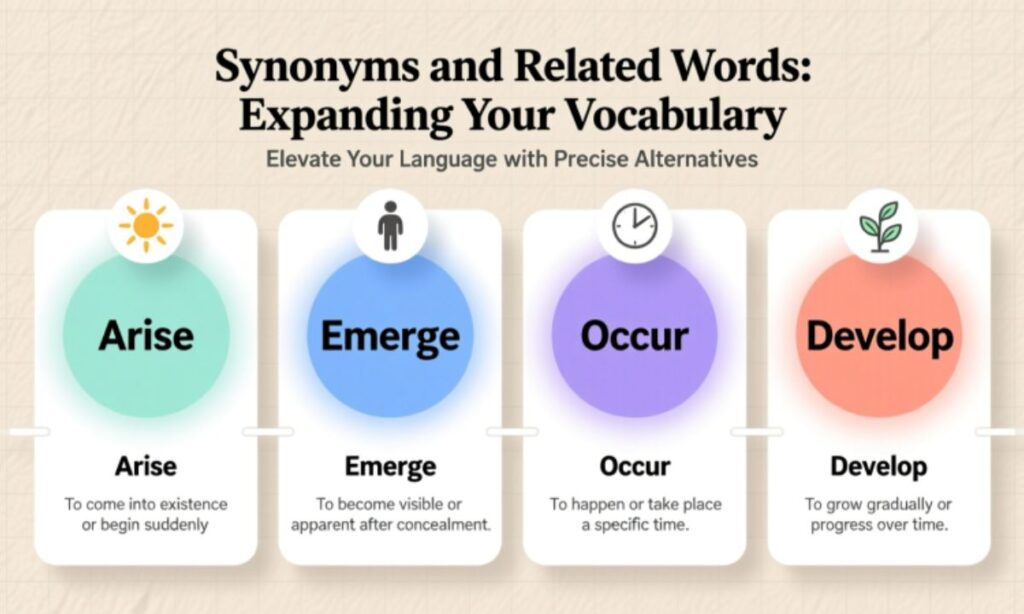
Diversifying vocabulary prevents repetition and adds nuance. This table shows alternatives while reinforcing arose vs arised correctness:
| Present Tense | Past Tense | Example Sentence | Usage Context |
| Arise | Arose | The situation arose suddenly. | General emergence |
| Emerge | Emerged | A solution emerged from discussion. | Becoming visible |
| Occur | Occurred | The incident occurred yesterday. | Events happening |
| Develop | Developed | Complications developed overnight. | Gradual formation |
| Appear | Appeared | Problems appeared unexpectedly. | Coming into view |
| Surface | Surfaced | New information surfaced today. | Previously hidden |
| Originate | Originated | The concept originated in research. | Beginning point |
| Materialize | Materialized | Opportunities materialized quickly. | Becoming real |
| Manifest | Manifested | Symptoms manifested within hours. | Becoming evident |
Choosing between synonyms depends on context and desired connotation. “Emerge” suggests gradual appearance, while “occur” emphasizes events happening.
Common Pitfalls and How to Avoid Them
Even with understanding English grammar rules, mistakes happen. Awareness of common pitfalls in verb tenses prevents errors in professional writing and conversation.
Confusing “arise” with “raise”: These sound similar but differ fundamentally. Raise vs arise represents a transitive versus intransitive verb distinction:
- ❌ Incorrect: The manager raised a question. (If meaning it emerged)
- ✅ Correct: A question arose during the meeting.
Mixing “arose” and “arisen”: Past tense versus past participle of arise requires different grammatical contexts:
- ❌ Incorrect: The problem has arose recently.
- ✅ Correct: The problem has arisen recently.
Using “arised”: Never acceptable under any circumstances in standard English:
- ❌ Incorrect: The issue arised unexpectedly.
- ✅ Correct: The issue arose unexpectedly.
Passive voice errors: Since “arise” is intransitive, passive voice errors occur when treating it as transitive:
- ❌ Incorrect: The concern was arisen by staff.
- ✅ Correct: The concern arose among staff.
Confusing “arise” with “rise”: While rise vs arise share roots, usage differs subtly:
- Less common: The sun arises in the east.
- Preferred: The sun rises in the east.
The Arise Challenge: Test Your Knowledge
Test comprehension with this grammar quizzes for learners section. These questions reinforce Arised or Arose What’s the Correct Past Tense of Arise understanding:
- Fill in the blank: New complications _ during surgery.
- Choose correct form: The issue had (arose/arisen) before we arrived.
- Is this correct? “The opportunity arised suddenly.”
- What’s the present participle of arise?
- Complete: “She _ to the challenge admirably.”
- Fill in: “If problems _, contact management immediately.”
- Which is correct: “The question was arose” or “The question arose”?
- What’s third-person singular present of “arise”?
- Fill in: “By morning, thick fog had _ over the valley.”
- Is “arise” transitive or intransitive?
Answers:
- arose
- arisen
- No, should be “arose”
- arising
- rose (idiom uses “rise,” not “arise”)
- arise
- The question arose
- arises
- arisen
- Intransitive
Scoring 8+ correct indicates strong mastery of these grammar learning tips and verb conjugation principles.
Beyond English: “Arise” in Other Languages
Examining cross-linguistic patterns reveals universal challenges with irregular verbs. This difference between regular and irregular verbs exists across languages, creating parallel ESL learner challenges.
| Language | Present Tense | Past Tense | Meaning |
| French | se lever | s’est levé | to get up |
| German | entstehen | entstand | to come into being |
| Spanish | surgir | surgió | to arise, emerge |
| Italian | sorgere | è sorto | to arise, emerge |
| Russian | возникать | возник | to arise, emerge |
| Japanese | 起こる (okoru) | 起こった (okotta) | to occur, arise |
| Mandarin | 出现 (chūxiàn) | 出现了 (chūxiàn le) | to appear, arise |
| Portuguese | surgir | surgiu | to arise, emerge |
| Dutch | ontstaan | ontstond | to arise, originate |
This universality demonstrates that irregular past tense examples challenge learners globally. Understanding how to master English verbs requires accepting irregularity as linguistic reality.
The Impact of “Arise” in Different Fields

Professional contexts demand precision, making correct verb tense in formal writing essential. Different fields use “arise” with specific connotations and grammatical correctness expectations.
In Law
Arise in legal writing carries precise meaning. Legal documents require absolute accuracy in verb forms in English:
- “All disputes arising from this contract require mediation.”
- “The plaintiff’s claims arose from alleged breach of duty.”
- “Rights and obligations arise upon contract execution.”
- “Jurisdiction arises when parties enter the forum state.”
In Business
Arise in business language discusses opportunities, challenges, and market changes:
- “Strategic advantages arose from the merger.”
- “The need for restructuring arose after financial review.”
- “New market segments are arising from technological innovation.”
- “Operational challenges arose during expansion.”
In Science
Arise in scientific context describes phenomena emergence and hypothesis development:
- “Unexpected results arose during experimentation.”
- “Questions arose regarding methodology validity.”
- “New theories have arisen from recent observations.”
- “Complications arose when controlling for variables.”
In Philosophy
Arise in philosophy explores consciousness, ethics, and conceptual origins:
- “Moral dilemmas arise when values conflict.”
- “The question arose whether free will exists.”
- “Consciousness arises from neural complexity.”
- “Ethical concerns arise with artificial intelligence.”
Types & Categories
Understanding verb forms in English requires categorizing “arise” properly. This classification helps learners apply English grammar rules systematically.
Verb Type Classification:
- Irregular Verb: Doesn’t follow standard “-ed” pattern
- Intransitive Verb: Takes no direct object
- Strong Verb: Changes internal vowel for conjugation
- Germanic Origin: Descended from Old English verbs
Semantic Categories:
- Physical movement (getting up, ascending)
- Abstract emergence (problems, opportunities)
- Temporal occurrence (events happening)
- Causal origin (stemming from conditions)
Grammatical Features:
- No passive voice construction
- Requires helping verbs for perfect tenses
- Third-person singular adds “-s”
- Progressive forms use “-ing”
This categorization aligns with how to master English verbs by understanding systematic patterns within irregularity.
Origins of the Word “Arise”
The history of the word arise traces back through Old English language evolution to Proto-Germanic roots. Understanding origins of the word “arise” illuminates why it maintains irregular conjugation.
Etymology Timeline:
- Proto-Germanic: *uzrīsanan (to rise up)
- Old English: ārīsan (prefix “ā-” + “rīsan”)
- Middle English: arisen (retained vowel changes)
- Modern English: arise (standardized spelling)
The prefix “a-” (from Old English “ā-“) intensifies meaning, distinguishing “arise” from simple “rise.” This Old English language evolution preserved strong verb patterns in English resisting regularization pressures.
Related verb transformation patterns in Germanic languages:
- German: aufstehen (auf + stehen)
- Dutch: opstaan (op + staan)
- Swedish: uppstå (upp + stå)
These cognates demonstrate shared linguistic ancestry and parallel irregular verb structures across Germanic language family.
A Final Look at the Past Tense of “Arise”
Mastering Arised or Arose What’s the Correct Past Tense of Arise transcends mere memorization. This understanding enables clear, confident communication in professional and casual contexts.
The difference between arose and arised is absolute, only “arose” achieves grammatical correctness.
Key principles to remember:
- Arose is correct; “arised” never exists in standard English
- “Arise” belongs to irregular verbs with ancient roots
- The verb conjugation follows strong verb patterns: arise, arose, arisen
- Context determines whether “arise” or synonyms better express meaning
- Professional fields require precision in correct verb tense in formal writing
This comprehensive guide equips you with grammar learning tips and practical how to use arise in a sentence knowledge. Whether composing business correspondence, academic papers, or casual messages, you’ll confidently navigate verb tense confusion.
So when facing Arised or Arose What’s the Correct Past Tense of Arise, trust your knowledge. Let confidence arise from understanding these principles.
Your mastery of this challenging English grammar rules aspect sets you apart as a careful, skilled communicator.
Read Also This: https://celebsmeaningcom.com/tyvm-meaning/
Frequently Asked Questions
Is it correct to say “arised” as the past tense of arise?
No, “arised” is incorrect; the correct past tense of “arise” is “arose.”
What is the correct past tense of the verb “arise”?
The correct past tense of “arise” is “arose.”
Do native English speakers use “arised” in everyday language?
No, native speakers do not use “arised”; they use “arose” instead.
When should I use “arose” instead of “arise”?
Use “arose” when talking about something that happened in the past.
Is “arisen” a real word related to arise?
Yes, “arisen” is the past participle and is used with helping verbs like “has” or “had.”
Can I say “a problem was arised” in correct English?
No, it should be “a problem arose,” not “was arised.”
What’s the difference between “arose” and “arisen”?
“Arose” is the simple past tense, while “arisen” is the past participle.
Why do some people say “arised” instead of “arose”?
It’s a common mistake based on regular verb patterns, but “arise” is an irregular verb.
How do I use “arose” in a sentence correctly?
You can say, “A sudden issue arose during the meeting.”
What is the correct form of arise for questions about past events?
Use “arose” when referring to past events, not “arised.”
Conclusion
Mastering Arised or Arose What’s the Correct Past Tense of Arise transforms your writing from uncertain to authoritative. Remember: “arose” is always correct, “arised” never exists. This grammatical correctness distinguishes skilled communicators from casual writers everywhere.
The journey through irregular verbs and verb conjugation patterns reveals English’s rich history. By understanding arose vs arised definitively, you’ve conquered one of English’s trickiest common grammar mistakes and strengthened your overall language mastery significantly.

